Numerical display
|
The numeric display is a component for displaying the numeric values received from the tag. |
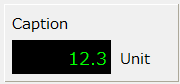
Specify the tag to be displayed in the input tag (_TagIn). You can specify any numeric format, such as the number of decimal places, whether to display delimiters, etc.
In addition to the input tag, by specifying a tag for fault identification in the fault identification tag (_TagFault), it is also possible to display a fault based on signals such as equipment abnormalities received from downstream.
Custom Properties
Tag configuration |
Input Tags |
_TagIn |
Specify the tag path of the input tag. |
Fault Identification Tag |
_TagFault |
Specifies the tag path of the fault identification tag. |
|
Display settings |
Number Format |
_Format |
Specifies the number format. |
Decimal point position |
_DecimalPlace |
Specify the number of decimal points as an integer. |
|
caption |
_Caption |
Specify a caption. |
|
unit |
_Unit |
Specify the units. |
|
Value Text Color |
_ValueTextColor |
Specifies the color of the value text. |
|
Value Background Color |
_ValueFillColor |
Specifies the background color of the value. |
|
Caption Color |
_CaptionColor |
Specifies the color of the caption. |
|
Unit Color |
_UnitColor |
Specifies the color of the units. |
|
Background Panel |
_BackPanelColor |
Specifies the color of the background panel. |
|
others |
Display value |
_Value |
You can directly assign a display value to this property from a script. |
Usage Example
1) Input tag specified/No fault identification tag
Displays the value of the tag specified in the input tag as a number.
|
The number is displayed according to the number format and decimal places defined in the custom properties. |
If the quality flag of the input tag is BAD, a fault is displayed.
|
The part will be framed in yellow and will flash. |
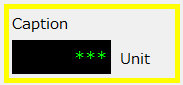
|
Various number formats are available (e.g. "@de" for Germany, "@ja" for Japan, etc.). You can also customize the number format to freely change the string displayed in a fault state (e.g. ***). For an overview of number formats, see Number Formats.
If you want to change the string displayed when the quality flag is BAD (QualityBad) as shown below, please refer to Number format (user format). Example: If you want to display a different string when the quality flag is BAD Example: When the quality flag is BAD, you want to display the final value when communication is successful.
|

2) Input tag specified/Fault identification tag
If you specify a fault identification tag, you can receive the fault status of the device via the tag. For example, if you can receive a fault status (such as a sensor abnormality) from the downstream side as a signal separate from the device's measurement value, you can specify the tag path of that signal as the fault identification tag to display the fault along with the state of the quality flag of the input tag.
|
When the fault identification tag is False, the value received in the input tag is displayed normally.
|
|
A fault is displayed when the fault identification tag is true or when the quality flag of the input tag is bad.
|
3) Change the number format
You can change the number format to display numbers in a variety of formats.
|
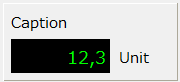
In this example, the number format is specified as "@de" (Germany).
*In German format, the decimal point is displayed as a comma instead of a period. |
4) Assigning values via script
You can display any numeric value entered from the script without specifying an input tag.
If you want to assign a value directly from a script, do so to the "_Value" property.
|
If you assign a value directly from a script, you cannot use a fault identification tag. For more information about scripts, see "Scripts". |
5) Other customization examples
You can customize the following:
|
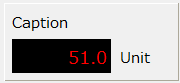
In the example on the left, by setting a bind, any value over 50 will be displayed in red.
|
|
For more information about binding, see "Binding". |